
Modeling intent as a system.
Early Purpose work used Color Petri Nets and later agent simulations to represent intent, action, feedback, insights, and outcomes as parts of an iterative system.
Development Question
Can intent remain explicit as it moves through action and feedback, rather than disappearing into the action it initiates?
Early System Model
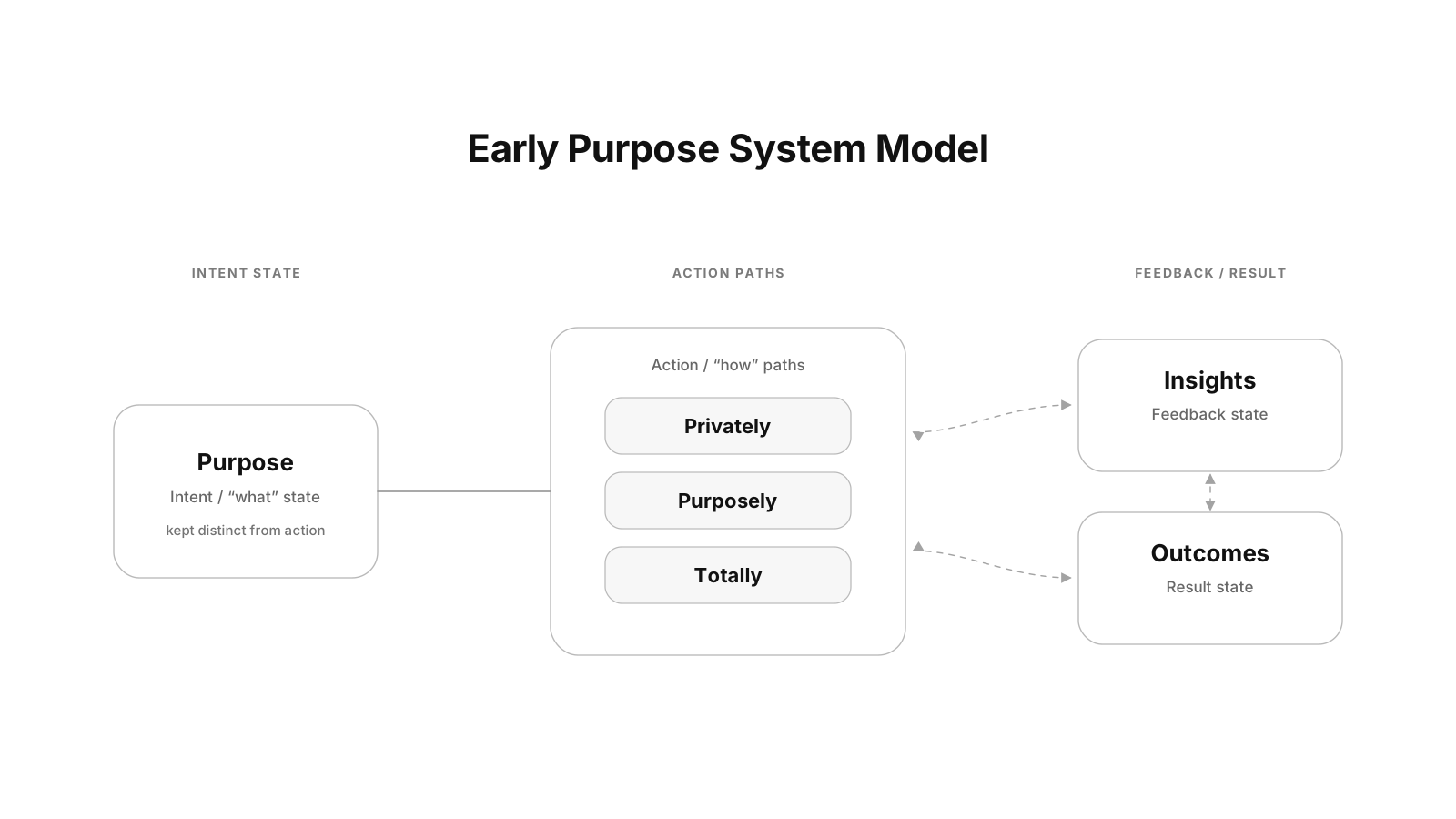
In January 2025, Purpose used a Color Petri Net to explore that question. The model separated an intent state from action paths and from insights or outcomes that could feed subsequent action.
Source note: The original January 2025 modeling reports remain in the private research archive. This page presents the public development summary.
The initial model represented Purpose as the intent or “what” state, with Privately, Purposely, and Totally as action paths. Insights and Outcomes represented states that could feed subsequent action. Tokens moved through the graph over repeated iterations to inspect how those relationships behaved.
During development, edge probabilities and node relationships were adjusted when some nodes depleted or accumulated too much state. That makes the model useful as a record of how the system was being structured and tested. It does not establish that the resulting flow is naturally stable or universally valid.
Later agent simulation
A later development experiment extended the model into a synthetic comparison using 10,000 simulated agents governed by defined behavioral rules: 5,000 in an intent-driven condition and 5,000 in an engagement-based condition, run across 100 cycles.
Simulation scope: outputs depend on the encoded rules, parameter choices, and defined success criterion.
Those distributions are outputs of the simulation, not measurements of human outcomes. The agent behavior, success criteria, feedback rules, and underlying model assumptions were defined within the experiment, so the resulting gap does not establish that intent-driven systems outperform engagement-driven systems in the world.
What the modeling supports
The retained modeling records support a narrower conclusion: early Purpose work represented intent, action, feedback, insights, and outcomes as separable parts of an iterative system, and later simulations explored how different behavioral assumptions changed trajectories within that model.
They do not establish real-world success rates, quantitative superiority of intent-driven systems, inevitable ecosystem growth, or performance at the simulated scale.
What carried forward
The durable result of the early modeling was not the size of a simulated performance gap. It was the structural question underneath it: how should intent remain visible as action and feedback change what happens next?
Later Purpose research brought that question into conversational AI. The focus shifted from modeling an ecosystem to examining how an assistant handles intent and uncertainty on the way to a response.